Artworks inside the Oklahoma State Capitol building in Oklahoma City depict the state’s historic events, natural resources and notable people. Beginning in 2022 and continuing into 2023, more than 20 new works commissioned for display in the building—most either representing Native American figures from Oklahoma, created by Native American artists with ties to the state, or both—will increase the number of Native artists and artworks on view by nearly 50 percent.
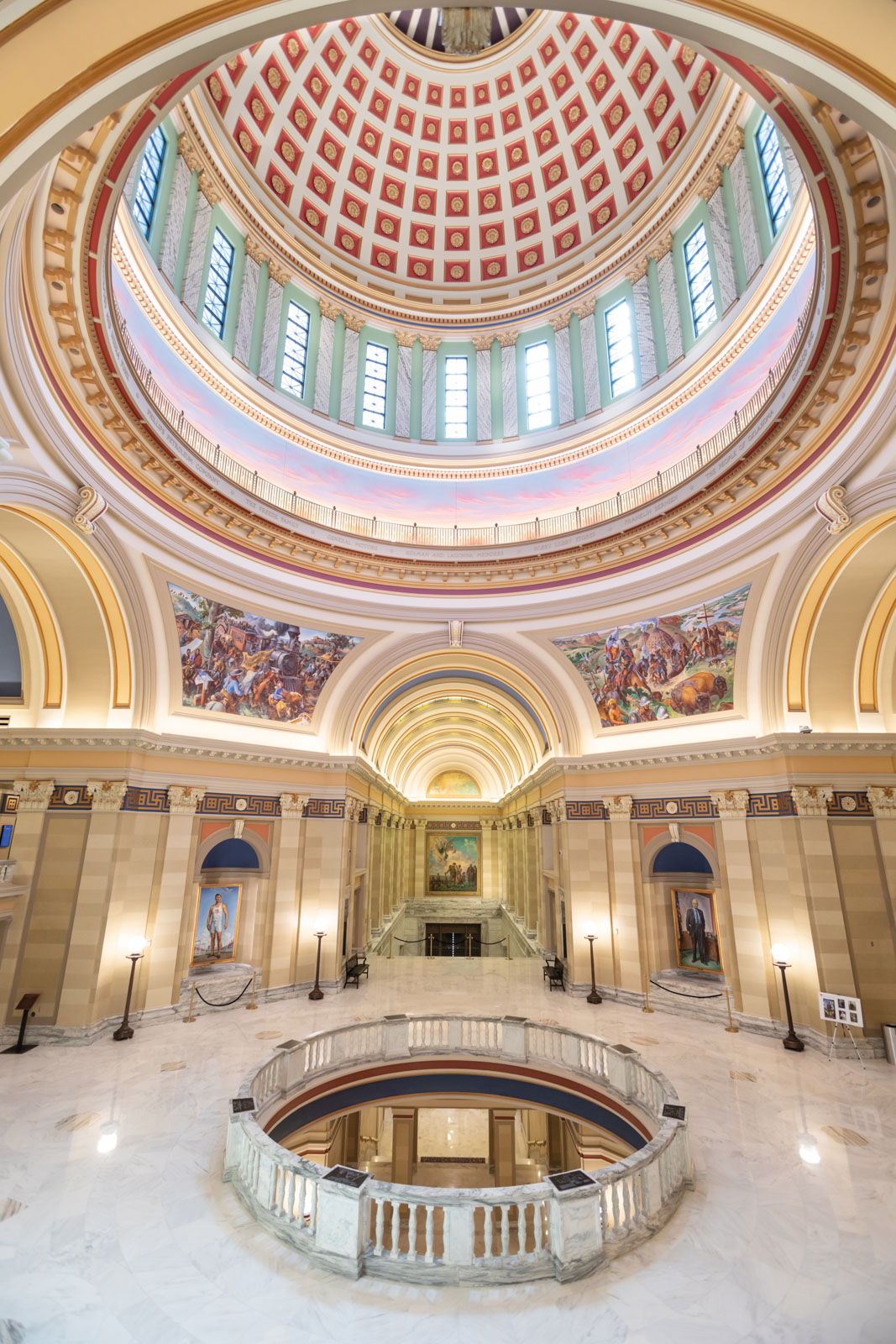
Oklahoma State Capitol interior. Photo by Oklahoma Legislative Service Bureau, courtesy of the Oklahoma Arts Council.
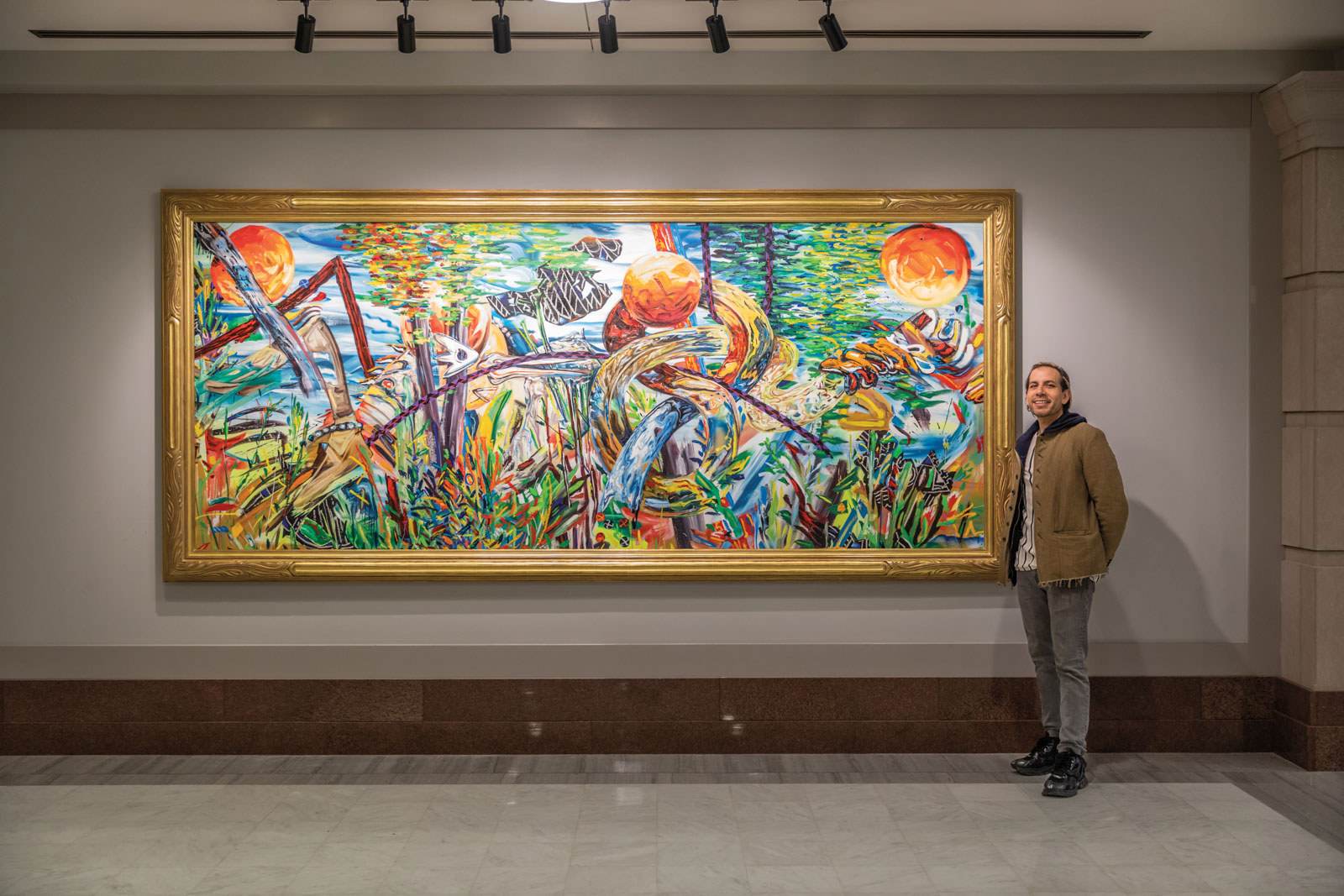
Yatika Starr Fields (Osage Nation/Muscogee Nation/Cherokee Nation) with his oil-on-linen work Spiro: Serpent River, Shelled Stories, Sun-Touched Engravings from the Oklahoma State Capitol Art Collection. Image courtesy of the Oklahoma Arts Council.
Anita Fields (Osage Nation) and Jessica Harjo (Otoe-Missouria/Osage Nation/Pawnee/Sac & Fox) produced installations. Dylan Cavin (Choctaw Nation) painted the Choctaw Code Talkers of World War I who predate the more celebrated Navajo Code Talkers from World War II. Nocona Burgess (Comanche Nation) painted family friend Doc Tate Nevaquaya. Chief Wilma Mankiller’s portrait was completed by Starr Hardridge (Muscogee Nation).
Of equal significance to their number is their placement.
When the Capitol’s tens of thousands of annual visitors enter the building through the main entrance on the ground floor, they will be greeted by a video from Buffalo Nickel Creative with the help of Sterlin Harjo (Seminole Nation/Muscogee Nation), co-creator and executive producer of the hit series Reservation Dogs. The greeting will incorporate Native languages from the state’s 39 tribal nations. Artwork throughout the ground floor reflects pre-statehood and Native American history in Oklahoma.
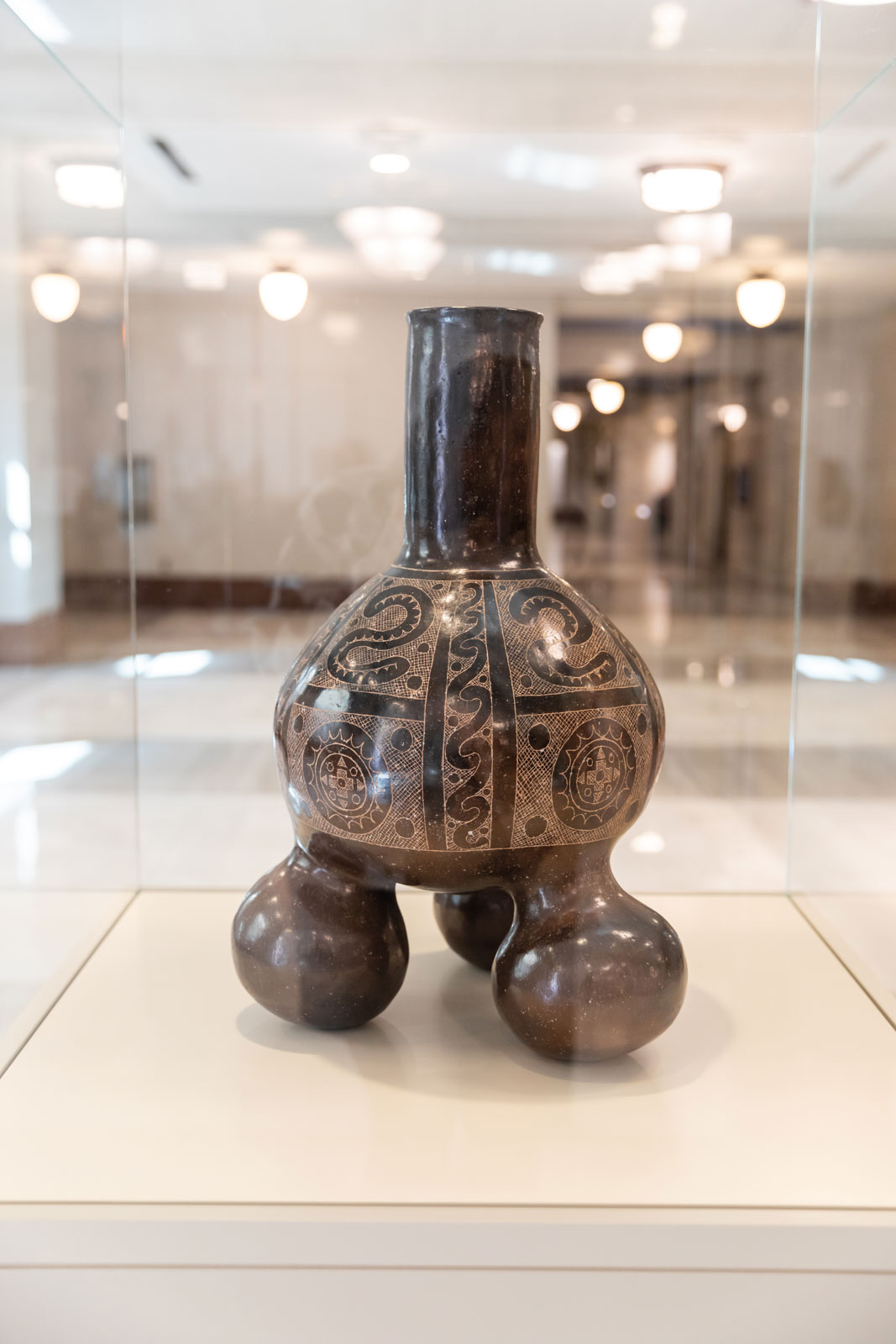
Below: Chase Kahwinhut Earles (Caddo Nation), Kadohadacho, hand-dug Oklahoma clay with crushed mussel shell, burnished with stone, pit fired in traditional Caddo methods, hand carved, 24 x 24 x 24”. From the Oklahoma State Capitol Art Collection. Image courtesy of the Oklahoma Arts Council.
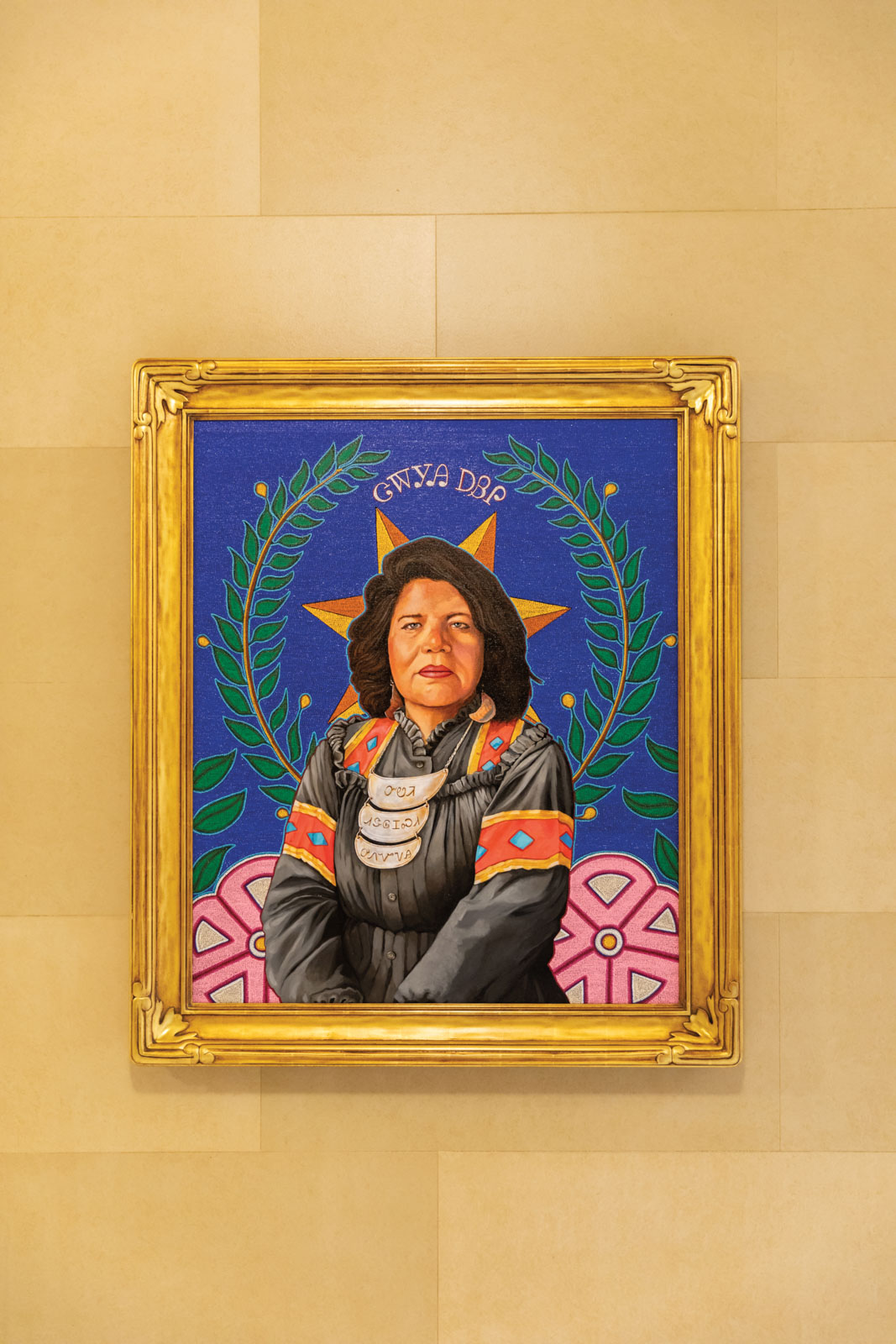
Starr Hardridge (Muscogee Nation), Chief Wilma Mankiller, acrylic paint and venetian plaster on linen, 36 x 30”. From the Oklahoma State Capitol Art Collection. Image courtesy of the Oklahoma Arts Council.
Makings perhaps the grandest statement is a mural by Yatika Starr Fields (Osage Nation/Muscogee Nation/Cherokee Nation) interpreting the Spiro Mounds. Spiro: Serpent River, Shelled Stories, Sun-Touched Engravings stretches a full 5 feet tall by 12 feet wide, produced with a vibrant, abstract energy conveying Spiro as a thriving center of commerce and nexus of cultural exchange in pre-contact Oklahoma.
“It’s very important to have Native American representation in these political spaces, in state entities, in every state, because every state has the history, every state has our traditional lands, of Indigenous peoples as stewards of those lands,” Fields says.
Most of the new works were made possible through the Oklahoma Art in Public Places Act requiring the state invest 1.5 percent of eligible capital improvement project budgets in public art. The Capitol building completed a major restoration project in 2022, which saw its more than 500 artworks previously on display be placed in storage for almost six years. Back on view, with the new commissions, the Capitol again doubles as the state’s largest art museum.
Fields, born and raised in Tulsa and now living there as well, had never been inside the Capitol building before receiving the commission. He had participated in protests outside of it. “I was pretty impressed,” he says after seeing the art collection on view there, “and I was happy to be part of it, but also that they incorporated [Native American] work in there and they try to create a dialogue and share a story. It’s needed; there needs to be a balance from the politics that are in there.”
While Fields was at the Capitol helping install his mural, he saw hundreds of schoolkids touring the building, a regular occurrence.
“It’s important that we have this work in there that people, younger people, non-Native people, non-Native students, youth, can be educated through our art—it’s the most powerful tool in my opinion as an artist,” Fields says. “[Artwork is] a lot stronger than words; words can help articulate it, but the art itself can move mountains if you let it happen.”
Spiro Mounds
Spiro, Oklahoma, is almost due east of Oklahoma City about 10 miles from the state’s border with Arkansas. The Spiro Mounds are located just outside of town.
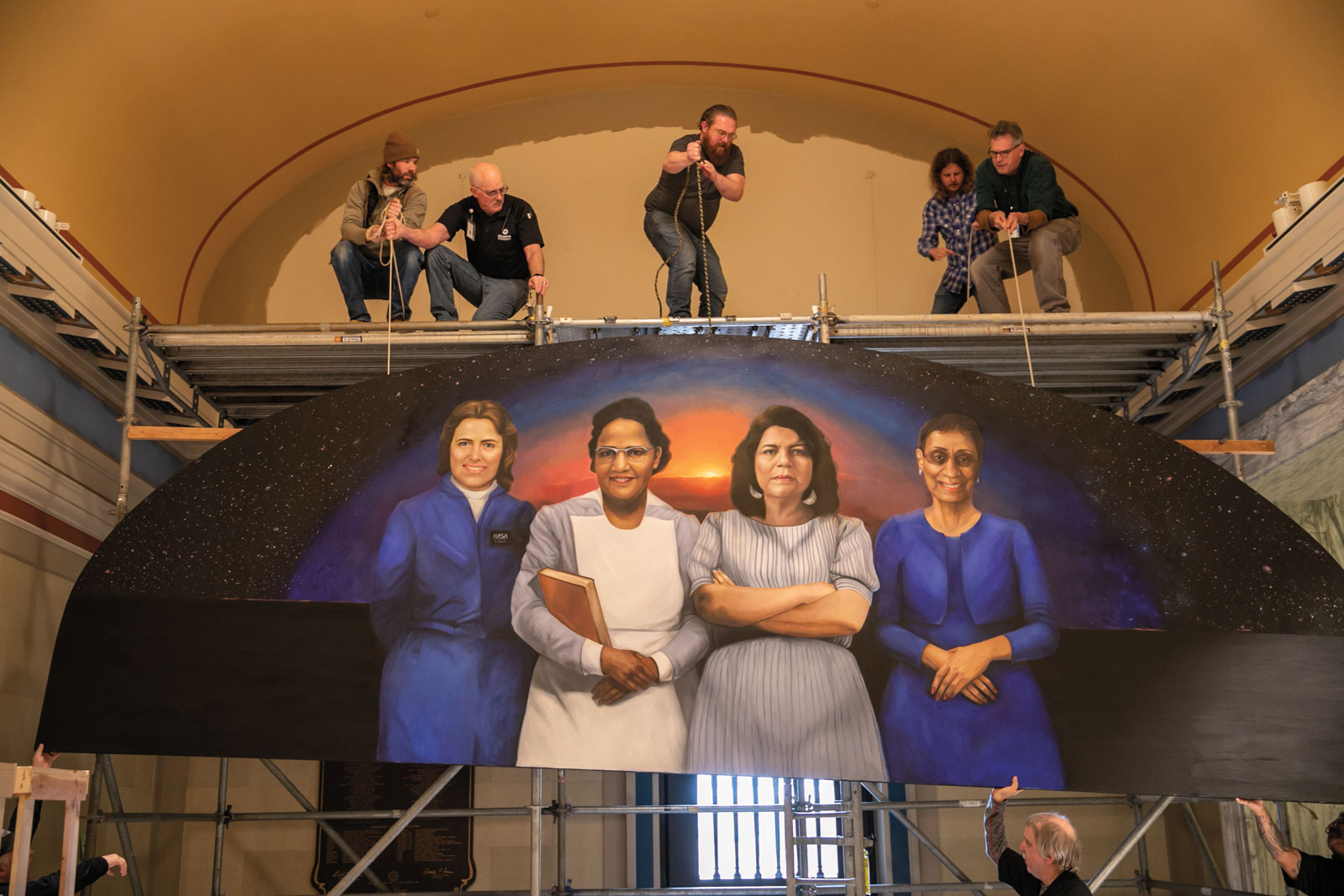
Sara Scribner, Making Her Mark, oil on linen, 9 x 22’. From the Oklahoma State Capitol Art Collection. The subjects are, from left to right, Dr. Shannon Lucid, Opaline Deveraux Wadkins, Chief Wilma Mankiller (Cherokee Nation, 1945-2010) and Senator Maxine Horner. Image courtesy of the Oklahoma Arts Council.
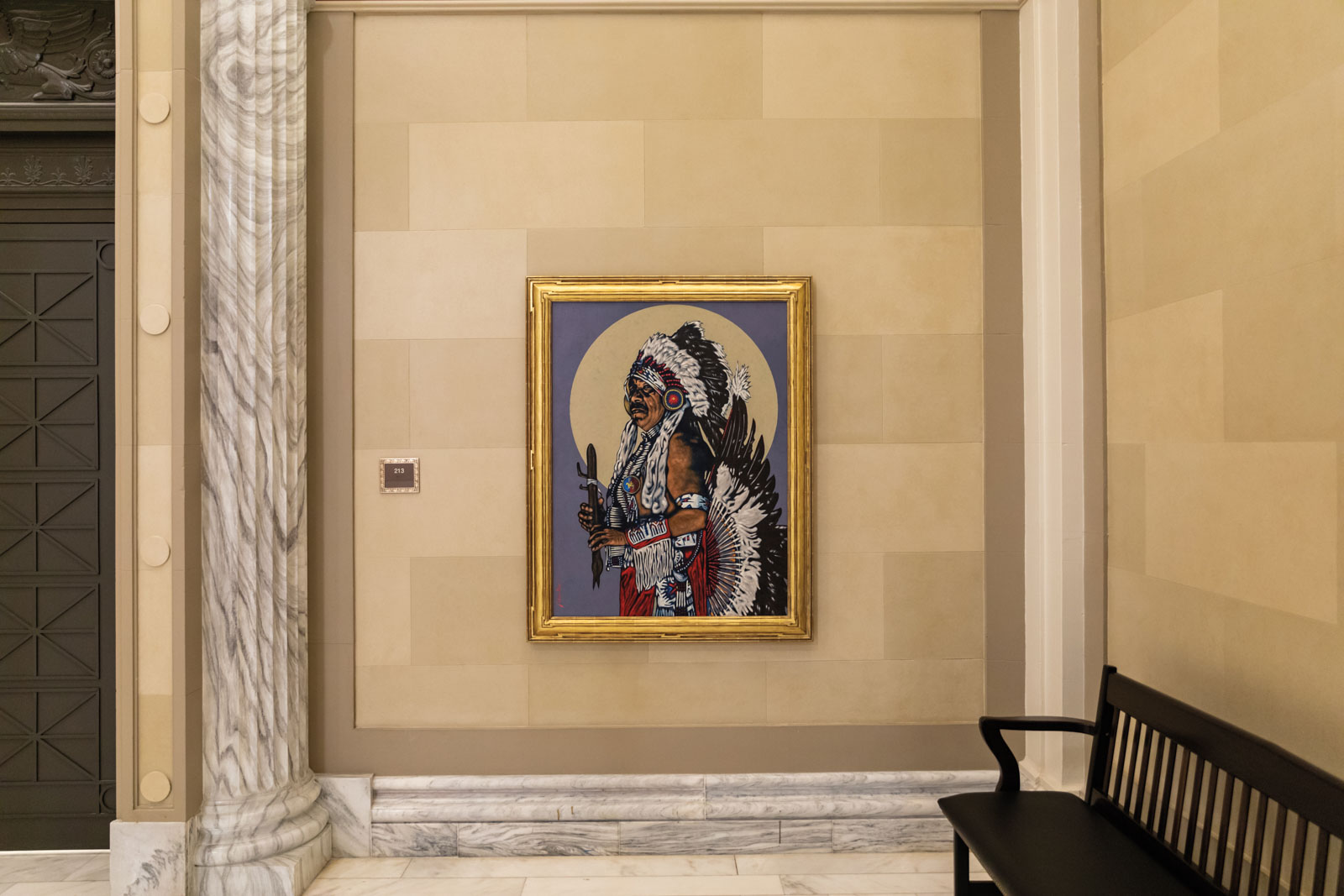
Nocona Burgess (Comanche Nation), Doc Tate Nevaquaya, acrylic on linen, 42 x 36”. From the Oklahoma State Capitol Art Collection. Image courtesy of the Oklahoma Arts Council.
The people who occupied the settlement from roughly 800 to 1450 developed a sophisticated culture with religious and political practices to go along with it. The residents at Spiro Mounds are thought to have been Caddoan speakers, like the modern Wichita, Kichai, Caddo, Pawnee and Arikara, according to the Oklahoma Historical Society.
Their influence was felt across the entire Southeast.
Especially remarkable was their participation in a trade network spanning nearly the entire North American continent. Twentieth-century excavations of the site—both official and by looters—revealed objects originating from the Gulf of California to the Gulf of Mexico and coastal Virginia to the Great Lakes.
A 1935 Kansas City Star article referred to the site’s “discovery” as a “King Tut’s Tomb in the Arkansas Valley.”
“I’ve always been drawn to the mound culture,” Fields says. “I’ve done work in the years prior to making this painting on the Mississippian culture, specifically effigy pots and painting murals of these effigy pots in different locations around Arkansas and Oklahoma and Kansas.”
As a child, he visited the most prominent of these sites, Cahokia Mounds, right across the Mississippi River from St. Louis in Illinois.
“These places were really special to me and magical to me, and it left me with an imagination of what it would be like to have lived back then or to imagine thousands of people, smoke rising, and what the systems would have been like, what the land would have been like,” Fields says. “When I went to Spiro to do [preparatory] sketches and walk through the space and place and imagine, I wanted to do something special for it, but it’s also in Oklahoma, along the Arkansas River, and I’m in Tulsa and the Arkansas River passes right by here as well.”
Spiro: Serpent River, Shelled Stories, Sun-Touched Engravings
Typically, Fields produces his artworks spontaneously.
“I start fresh and start making marks and kind of let something evolve; I have an idea where it’s going to go, but I don’t work from a set image or template or mock up,” he says.
The Oklahoma Arts Council, however, which managed the new Capitol commissions, wanted more than Fields’ word that his monumental painting, which would become one of the signature pieces of the collection for decades into the future, shared their vision for the project.
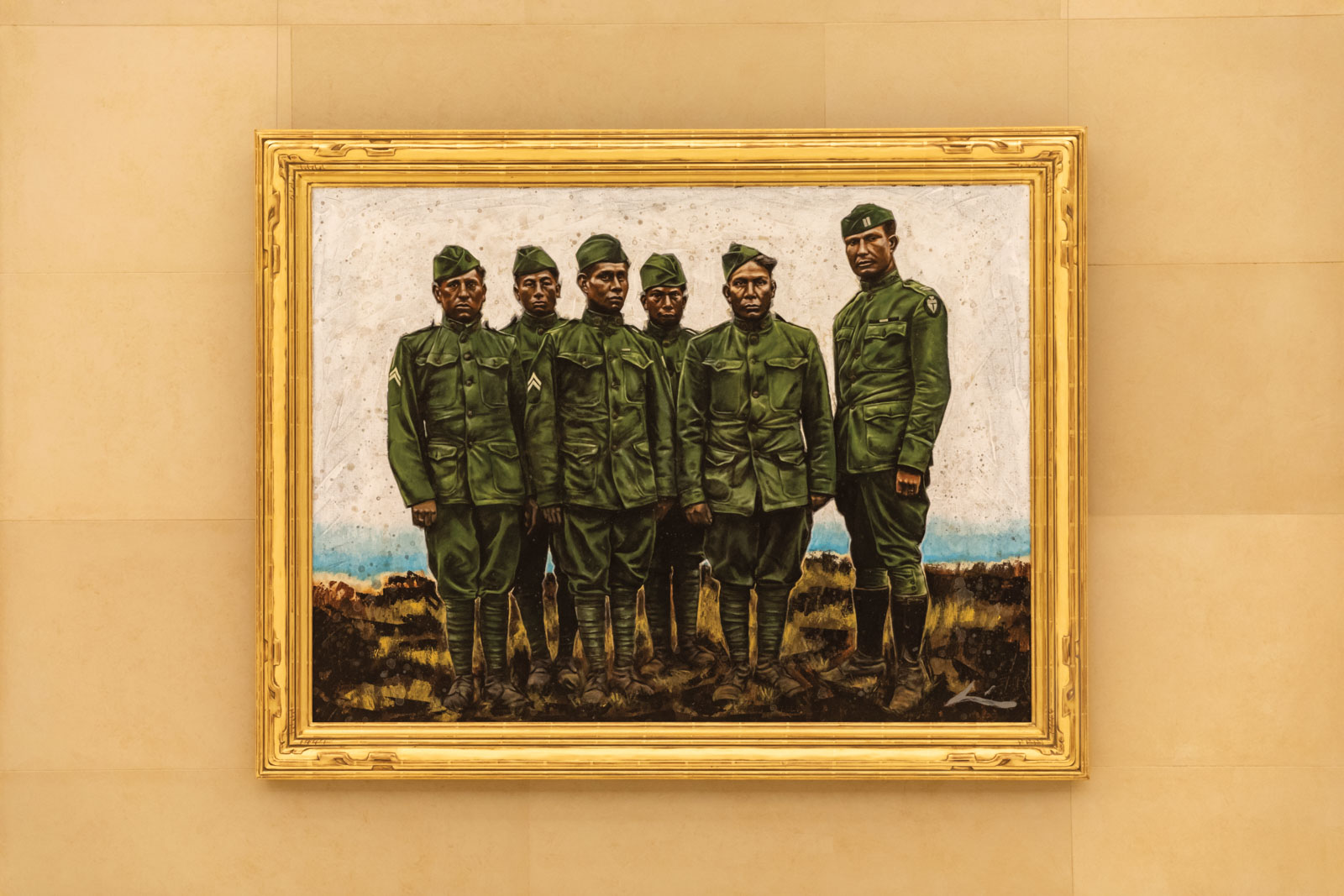
Dylan Cavin (Choctaw Nation), Anumpa Luma Anumpuli, acrylic on linen, 36 x 48”. Fhe Oklahoma State Capitol Art Collection. Image courtesy of the Oklahoma Arts Council.
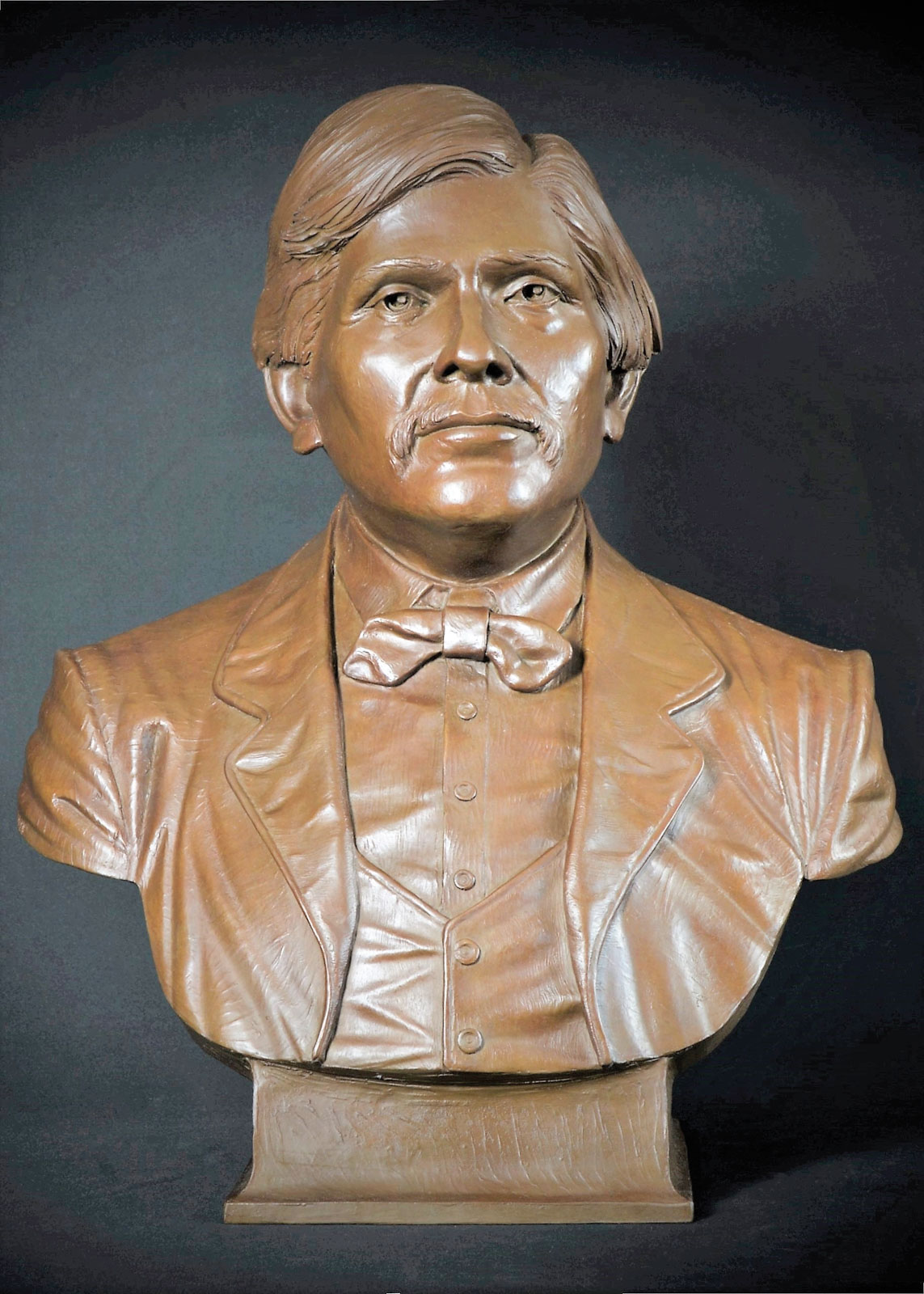
LaQuincey Reed, Chief Allen Wright, bronze, 23 x 17 x 11”. From the Oklahoma State Capitol Art Collection. Image courtesy of the Oklahoma Arts Council.
“They definitely needed something, and that’s challenging for me because I don’t like to work that way,” Fields admits. “You have to make something, you have to show them something, so I really had to make a compromise with this one. [I thought] let’s try to channel that energy into this mockup, so that’s what I did, I made a big watercolor painting on paper shortly after I took a trip down to Spiro to do a site visit and came up with a loose version of what you see now.”
What visitors see now is a dynamic, enthusiastic expression of color. Three orangey-red suns spread across a backdrop of cool blues and greens—water—with vigorous yellow and green brushstrokes at the bottom representing vegetation.
“It’s the most unique painting in the whole Capitol building because it is kind of an abstract representation of this conversation I’m trying to have with Spiro Mounds, whereas all the other paintings are beautifully, aesthetically created with realism,” Fields says.
A large figure-eight design in the middle of the painting recalls a serpent, the kind that was routinely placed on the engravings and ornaments found at Spiro.
“The suns are moving, like if you were to slow down the seasons, seasonal sun; I wanted that to be the main focal point when you walk in and be carried by the sun just as we are carried by it every day,” Fields says. “They were a highly agricultural community, and I wanted the sun to dictate how they were with their ceremonies, with their seasons and how the cosmos and sun were a part of their culture.”
Water, too, was essential.
“The water, for providing life, also for trade routes connecting them to other mound sites, mound communities,” Fields explains. “How water is a big part of their culture and ceremony just as it is for ours.”
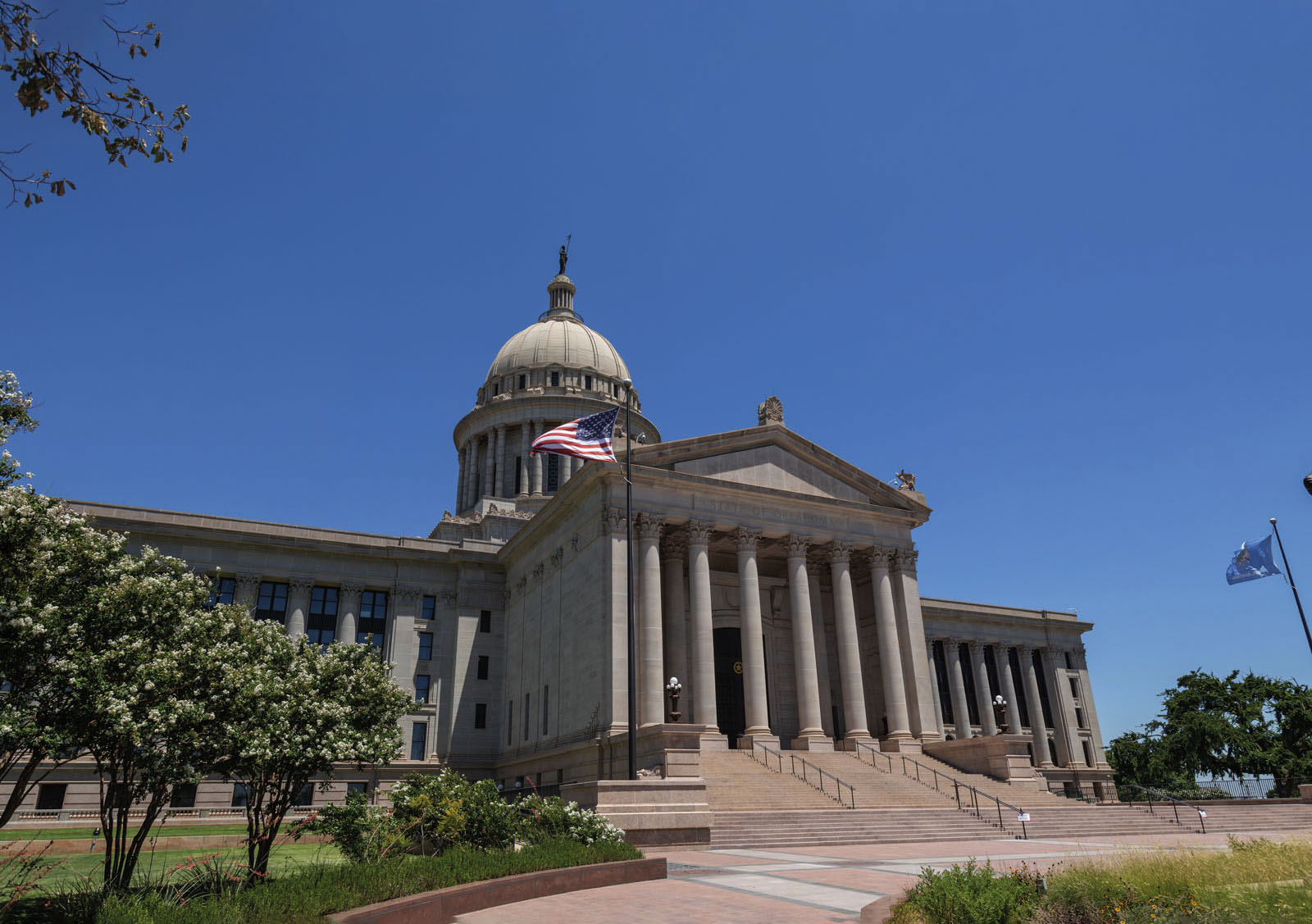
Oklahoma State Capitol. Photo by Oklahoma Legislative Service Bureau, courtesy of the Oklahoma Arts Council.
Fields hopes passersby stop in front of his painting to consider the indigeneity of the land and think about where they are. He’s thankful these long overlooked stories are being shared in the Capitol, and being shared from a Native perspective.
“When you have this art in these spaces, especially from Indigenous artists, it’s a breath of fresh air,” Fields says. “As a Native artist, I walk the lines, I walk the boundaries of being in a white world and having to facilitate my work in white spaces and having to navigate, negate and mitigate these long-term [interpretations] that can go wrong, and help tell our narratives and our story where they often aren’t, or [can] be misguided.”
Powered by Froala Editor